
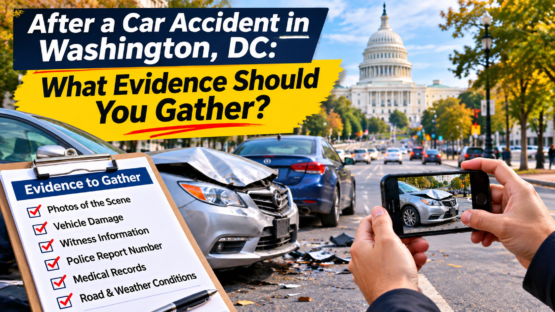
After a Car Accident in Washington, DC: What Evidence Should You Gather?
Shaken and confused and b) Unsure of what to do after an automobile accident. With car repairs to make, insurance calls to make, and hospital bills to pay, collecting evidence can feel like one more chore. But the information you possess after an accident can be priceless. Medical records, witness testimony, police reports, and images all detail the accident. Helping to build your case, the information you gather can also allow you to reinforce your claim if an insurance company challenges your injuries or faults. If you are harmed in Washington, D.C., your health should come first. Second, gather as much proof as you’re safely able to do.
Why Is Evidence Important After a Car Crash?
It helps to describe the events of the crash and who may be liable. It also helps in proving your damages. For example, photographs can show the damage to your vehicle or the road conditions. Medical records might link your injuries to the crash. Witness accounts may corroborate your version of events concerning the accident. Without good evidence, an insurance company can dispute your claim. It may question the source of your illness or the amount you’re asking for. If you have good records, you have facts on your side.
1. Photograph and video the scene
Photos may help you remember facts that you might forget within a few hours. If you can and are not wounded, pull out your smart phone and capture some images of the accident scene. Attempt to obtain:
- Damage to both cars.
- Position of each car and their registration plates.
- Traffic lights, signs, and lane lines.
- Skid marks and broken glass.
- Weather and road conditions.
- Injury photos (if visible).
Include wide and close-up photos. Wide shots show the complete area, and close-up images are detailed with something small. Both can be used to show the crash. Don’t endanger your life for photographs. 1. Get Out of Traffic, Call for Assistance
2. Get an Accident Report
Call 911 if you need police assistance or if there’s an injury. The cops can do a crash report and gather information from the persons involved. Police reports can contain:
- Driver names and contact details.
- Information on the car and insurance.
- Witness details.
- Accident. Place/time/date.
- Officer’s notes and observations.
The report may support your version of the accident. But it could be wrong or leave out essential facts. Check this for errors and suggest that errors be repaired according to the proper procedures.
3. Obtain the names and contact information of witnesses.
Other witnesses to the disaster may recall details you have forgotten. You may have been harmed, in shock, or concerned for medical assistance. Record the names and phone numbers of any witnesses. Ask them if they can explain what they saw in simple terms. Perhaps one of the observers witnessed the motorist blowing a red light. Another almost could have seen someone on a phone before the catastrophe. And this could be evidence of fault. Do not have someone do this for the agreement to your side. Instead, have everyone narrate what he/she has seen in his/her own words.
4. Gather all medical bills and paperwork.
Don’t Exert Yourself Stacking Up the Paperwork! See a doctor right away after the accident. Some injuries (such as whiplash or head trauma) can have delayed symptoms. Get a prognosis and examination from a doctor. Copies of:
- Hospital visits and ER visits.
- Doctor’s office/investigation records.
- Medications/Creams.
- Therapy bills.
- Estimates of future care and expenses.
- Other: Wages lost or time missed from employment.
These documents indicate how the accident affected your health and your income. Go to all of your appointments and do what your doctor advises you. If immediate treatment wasn’t sought after, it can question the severity of your injuries.
5. Obtain Footage from Dashcams and Traffic Cameras
Video can show exactly what happened. It can capture the speed of a car, traffic signals, changing lanes, or the time of the crash. Washington, DC, possesses multiple traffic cameras along popular passing roads and bridges. They might also be near businesses, homes, or parking lots. Check with property owners in the vicinity to see whether they have any records. Check quickly, since many systems save over video in a matter of time. You also may need to contact a DC Car Accident Lawyer to help you lawfully access any video. Some cameras don’t even record and save footage.
6. You And Your Car (And Your Money)
Whether you are engaged in an accident or not, your car may be an important piece of evidence. Don’t repair it or get rid of it until you’ve documented the damage. Store copies of repair estimates, inspection reports, and towing receipts in the car. If your automobile has an event data recorder or dash cam, talk to service manufacturers about storing the information. Also, make a record of the costs of your injuries. These could include medical treatment, transportation to medical treatment, lost wages, and help you hire around your house. Small things accumulate. Writing them down in a simple log prevents you from forgetting about them later.
7. Stay Current on Necessary Legal Deadlines
Which also implies saving evidence rapidly. And you have to preserve your claim. In Washington, DC, you generally have three years to bring personal injury cases to court. D.C. Code Section 12-301. Claims against the District government: reduced time limits. Generally, you have to give six months’ written notice in advance (D.C. Code §12-309). If police were involved, see if their documented police report satisfies the notice requirements. But don’t assume any report will comply with the law. You can get a crash report from the Metropolitan Police Department. Accident reports are available via the department’s Public Documents Unit.
How Can a DC Auto Accident Attorney Help You?
Gathering together all the facts following a serious incident can be daunting. A lawyer can help you sift through your records and uncover anything you may need that you don’t have. Price Benowitz Injury Accident Lawyers, LLP, is a Washington, DC law firm specializing in representing injured clients in motor vehicle accidents. Its cases include automobile, truck, motorcycle, bike, bus, and pedestrian accidents. It also specializes in spinal cord and key burn victims. How a DC Car Accident Can Help:
- Reviewing the circumstance of the accident and police reports.
- Acquiring traffic camera footage.
- Getting medical records and witness statements.
- Determining accountable (or criminal) parties.
- Evaluating medical expenditures and missed wages.
- Negotiating with the insurance company.
- Not knowing about claim deadlines and options.
Promptly getting legal advice can prevent you from losing evidence. Legal help might also prevent insurance mishaps.
Common questions
- What Is the Procedure for Collecting Evidence to Use for My DC Car Accident Case?
Short answer: Collect photos, videos, police reports, witnesses, medical records.
Long answer: If applicable, photograph damage to your automobile, signs, and road conditions. Get witness info and the police report. Hang on to your hospital bills and lost paychecks. They can bolster your injury claim.
- How about photos after the accident?
Short answer: YES, YES, if it is safe to get a photo.
Long answer: Photograph the cars, the plates on the police car, street signs, and any evident injuries. Take shots from numerous angles. Photos of the accident and damage you had taken would serve to document it.
- How can you obtain a police accident report in Washington, DC?
Short answer: Yes, the DC Metropolitan Police Department will produce a report for you.
Long answer: MPD Public Documents Unit, Accident Reports Some reports require the name of the requester, date of crash, location of crash, and report number. A first-party request will often require an application and ID.
- Will the statements of witnesses strengthen my claim for a car accident?
Short answer: yes. Witnesses can corroborate your story of the accident.
Long answer: They may have seen another vehicle running a red light, changing lanes, or texting on their phone. Their testimony can assist explain what occurred. Immediately after the accident, write down their contact information.
- How long should you keep your car accident evidence?
Short answer: Keep all evidence while your claim and lawsuit are pending.
Long answer: Maintain photos, medical documents, bills for repairs, insurance correspondence, and signed/witnessed contact information. Create copies on paper and digitally when there’s a way to do so. Save all important records until you have consulted with an attorney.
However, Bottom Line Fast
That Evidence Could Change Everything in a Car Accident in Washington, DC… Little details can turn into important facts later on. Go to a physician, document, and do not wait until evidence is destroyed. If you have serious injuries, legal help will support your rights.