
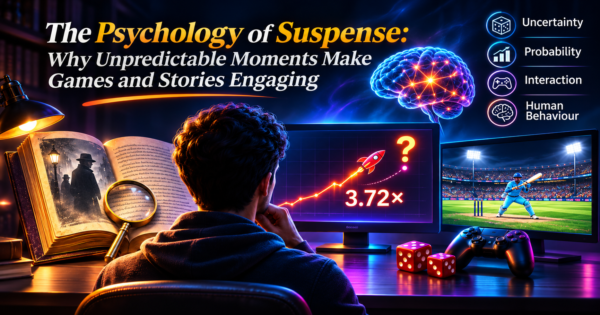
Suspense is one of the most powerful elements in storytelling and entertainment. Whether someone is reading a mystery novel, watching a dramatic cricket match, or playing a digital game, uncertainty creates anticipation and keeps attention focused on what happens next.
Writers have used suspense for centuries to build emotional connections with audiences. Today, digital entertainment developers apply similar psychological principles through interactive experiences, real-time feedback, and unpredictable outcomes.
Understanding the relationship between suspense, probability, and human behaviour reveals why certain experiences remain memorable long after they end.
Why the Human Brain Responds to Uncertainty
People naturally seek patterns and explanations. When an outcome remains unknown, the brain attempts to anticipate what might happen next.
This process explains why mystery novels, dramatic films, and competitive games can hold attention so effectively.
In digital entertainment, uncertainty can be created through randomised events, timed decisions, or changing visual elements.
For example, crash games in India use rising multipliers that can stop unpredictably, creating a sense of anticipation around an uncertain outcome. Unlike fictional suspense, however, these games can involve financial losses, and previous results cannot reliably predict future rounds.
The psychological principle is similar across entertainment formats: uncertainty encourages audiences to focus on the next development.
How Writers Create Suspense Through Storytelling
Suspense is not simply about surprising an audience. Effective storytelling gradually introduces questions that readers want answered.
A mystery writer might reveal an unusual clue while withholding the explanation. A romantic story may create uncertainty about whether two characters will reunite.
These techniques encourage readers to imagine possible outcomes.
Pacing is particularly important. Short sentences can increase urgency, while longer descriptive passages allow tension to develop gradually.
Writers also use foreshadowing, dramatic irony, and unexpected changes in perspective to maintain interest.
The difference between suspense and surprise is timing. Surprise happens suddenly, whereas suspense develops through anticipation.
This distinction helps explain why a carefully constructed story can remain engaging even when readers suspect how it might end.
The Role of Probability in Digital Games
Probability determines how likely different outcomes are within a system.
In digital games, random number generators can produce results according to predefined mathematical rules.
These systems may control anything from virtual card distributions to randomly generated environments.
However, randomness is frequently misunderstood.
People sometimes believe that a particular result becomes more likely simply because it has not occurred recently. This misconception is known as the gambler’s fallacy.
For independent random events, previous outcomes do not change the probability of the next result.
Understanding this distinction is important when evaluating games involving chance.
The American Psychological Association’s psychology resources provide broader information about cognitive processes, decision-making, and human behaviour.
Why Interactive Entertainment Feels Different
Traditional stories usually follow a fixed sequence. Readers experience events in an order chosen by the author.
Interactive entertainment introduces decisions that can influence how an experience unfolds.
Video games may allow players to select dialogue, explore alternative routes, or complete challenges in different ways.
These choices can create a stronger sense of participation.
However, not every interactive system gives users control over the final outcome.
Some games rely on predetermined probabilities or randomised results, regardless of the decisions made during play.
Recognising the difference between meaningful choices and random outcomes helps explain how interactive experiences are designed.
How Sound and Visual Design Build Anticipation
Suspense depends on more than narrative structure.
Sound effects, music, animation, and colour can influence how audiences interpret events.
A sudden silence before an important scene may create tension, while faster animation can suggest urgency.
Game developers use similar techniques through progress indicators, countdowns, and changing visual elements.
These features provide feedback and help users understand what is happening.
However, when financial decisions are involved, interface design should avoid misleading users about their chances of success.
Visual excitement does not change mathematical probability.
The Importance of Responsible Digital Design
Modern entertainment platforms have access to sophisticated tools for measuring user engagement.
Developers can analyse session duration, interaction patterns, and responses to different features.
This information can help improve accessibility and technical performance.
However, engagement-focused design also raises ethical questions.
Features that create constant urgency or encourage repeated participation may become problematic when users experience financial or emotional harm.
The World Health Organization’s information on gaming disorder explains how persistent gaming behaviour can become harmful when it significantly interferes with everyday functioning.
Responsible developers should prioritise transparency, meaningful user controls, and appropriate safeguards.
What Storytelling Can Teach Digital Entertainment
Writers and game developers share a common challenge: maintaining interest without overwhelming their audiences.
Both rely on pacing, emotional engagement, and carefully structured experiences.
A successful story provides enough information to create curiosity while allowing readers to understand the narrative.
Similarly, well-designed digital entertainment should make its rules and outcomes understandable.
Suspense can make an experience memorable, but confusion and misleading information can undermine trust.
The most effective entertainment balances excitement with clarity.
As storytelling and technology continue to influence one another, understanding the psychology of anticipation will remain valuable for writers, designers, and audiences alike.